Copenhagen-based architect BIOSIS was behind the recent 15,000 sq m extension to Lagunen Storsenter, Norway’s largest shopping centre, in a project that has sought to recast the contemporary mall as a climate-responsive urban quarter rather than as a sealed retail box.
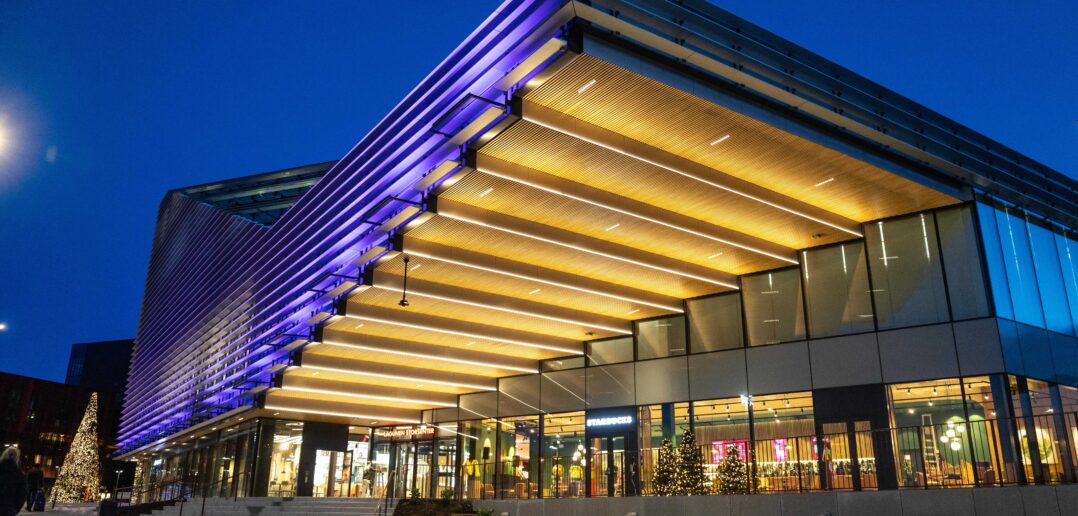
Known as Lagunen II, the expansion sits in Bergen’s Fana borough, a coastal district defined as much by the heavy rainfall in the area as by its suburban growth. Rather than shielding the development from the weather, the architect has used it as the starting point for the design. A deep, cantilevered roof sweeps across the frontage, creating a covered public realm intended to shelter pedestrians from the city’s frequent downpours. Timber-lined soffits also lend warmth to the structure, which projects outward to form a covered threshold between the mall and its local environs.
Bergen’s high annual rainfall has long shaped local building traditions in the region and BIOSIS’s approach has attempted to update that approach, with transparent façades and recessed ground floors softening the boundary between interior and exterior, allowing cafés, small plazas and pedestrian routes to blend into one another. The result is less inward-looking than many Scandinavian malls of the late 20th century.
At the centre of the new wing is a multi-storey atrium designed to draw daylight deep into the scheme in a city where winter light is limited. Retail space occupies the lower levels, including Bergen’s first branch of Zara, while restaurants and cafés line the street edge, with offices situated above.
The mixed-use configuration reflects the broader shifts in European retail real estate, as landlords incorporate workplaces and hospitality alongside stores and Lagunen II is positioned as a local anchor rather than a standalone commercial destination. The wider centre, including the original complex, now accommodates more than 200 businesses and draws over eight million visitors annually.
From an environmental perspective, horizontal aluminium fins partly manufactured from recycled material and to moderate solar gain during brighter months, while planted terraces and green walls aim to reduce heat build-up and increase biodiversity. The building is targeting Norway’s Energy Class A rating and BREEAM In-Use certification.
The mall is owned by Thon Group, Norway’s largest owner and operator of shopping centres, with a portfolio that extends into Sweden. It manages more than 70 centres across the two countries, including in the Oslo region Storo Storsenter, Sandvika Storsenter, near the capital and historically among Norway’s busiest malls, Strømmen Storsenter, which is one of the country’s largest shopping destinations, and Ski Storsenter, a suburban centre in Akershus.
Thon Hotels is one of Norway’s leading hotel chains with hotels throughout the country, in addition to Sweden, Denmark, Belgium and the Netherlands, plus several partner hotels, while under the name Resthon it owns and operates a number of restaurants and bars in several Norwegian cities.