
Women are increasingly visible in the upper echelons of retail and retail real estate investment and development, yet the sector remains structurally male-dominated, with persistent pay gaps and a slow trickle of women into the top roles.
The tension between high-profile female success stories and the underlying numbers is particularly stark in Europe and Asia-Pacific, where some of the most powerful owners and developers of retail assets are based. And there are plenty of recent surveys painting a picture of the global position.
Published in November, the 2025 CREW Network Benchmark Study Workplace Data and Trends in Commercial Real Estate showed that the industry is making progress, yet it also pointed out that women continue to navigate an uneven playing field in what remains a male-dominated industry.
“While the representation of women in the industry remains stagnant, the compensation gap is narrowing and women have more work flexibility than ever,” said CREW Network CEO Alison Beddard of the study, which US-based CREW released in partnership with the Massachusetts Institute of Technology Center for Real Estate with support from the CREW Network Foundation, the ICSC, the Mortgage Bankers Association and NAIOP.
For the first time in the 20-year history of the study, women reported that gender discrimination in the workplace was their primary barrier to success. Other reasons were work-life balance, lack of promotion opportunity, lack of mentors/sponsors and family/parenting responsibilities. In contrast, the top barrier for men was work-life balance. Among the 2,450 respondents, 44% worked in retail real estate, with pay disparity for women 6% below men in fixed base salaries and 11% less in overall annual compensation.
The irony is that retail has become a more forward-looking asset class within commercial real estate, noted ICSC COO Whitney Livingston: “It’s where we’re seeing the most innovation around mixed-use and community placemaking and adaptive reuse, and many of the women who are leading that transformation are bringing immense value,” she said.
Meanwhile, the latest edition of LEAD Network’s Gender Diversity Scorecard has revealed that the percentage of women in senior executive positions across European retail and consumer goods industry has risen to 39%, from 37% in 2024.
The biennial scorecard was first launched in 2017, when a quarter of senior executive positions were held by women, so there has been continued, albeit slow, progress. In consumer goods and manufacturing, the percentage of women in senior roles stands at 42%, up 4% since 2023, while in retail it stands at 36%, compared with 35% in 2023.
“It’s encouraging to see the needle moving in the right direction, and the commitment behind this progress is worth recognising,” said Allyson Zimmermann, CEO of LEAD Network. “However, the pace of change remains far too slow. Advancing gender equity requires a strategic, systemic, and long-term approach.”
However, in Europe a new generation of women are at the helm of major retail property platforms, from listed REITs to private equity-backed managers. Joanna Fisher, as chief executive of ECE Marketplaces, oversees one of the continent’s largest shopping centre portfolios. At Hammerson, the retiring Rita-Rose Gagné led a strategic overhaul of the UK-listed retail REIT as CEO, shedding non-core assets, deleveraging the balance sheet and refocusing the business on prime city centre destinations and mixed-use regeneration schemes.

Joanna Fisher
And at Pimco Prime Real Estate (formerly Allianz Real Estate), Annette Kroeger, chief executive for Europe, directs investment strategy across key markets including Germany, Austria and the Nordics, with responsibility for multi-billion-euro mandates that encompass large retail-led assets.

Annette Kroeger
Also in Europe, Sara Lucas, former chief executive of Grosvenor Property Europe and now a supervisory board member at Unibail-Rodamco-Westfield, has decades of experience in European retail and mixed-use assets, while Vanessa Simms, chief financial officer of Landsec, has played a central role in refocusing the UK REIT’s capital towards destination retail and mixed-use schemes.

Sara Lucas
There has also been progress in some of retail’s less mature markets. In Central and Eastern Europe, figures such as Tanya Kosseva-Boshova, managing partner at Lion’s Head and chair of the Association of Commercial Building Owners in Bulgaria, has driven the development and leasing of regional shopping centres and office complexes, often as the first woman at the table in those markets.
Meanwhile, in Europe’s outlet retail sector, Susie McCabe’s role as co-CEO of McArthurGlen highlights another dimension of modern retail property leadership, the fusion of brand strategy and placemaking, while in Italy Valeria Falcone’s leadership at Colliers reflects the growing importance of advisory services in established real estate markets.

Susie McCabe
In the United States, where retail real estate has long been defined by scale and innovation, Mary Ann Tighe’s career exemplifies strategic vision in an urban context as a senior leader at CBRE in New York. She has overseen transactions that have helped shape some of the world’s most valuable commercial areas, influencing not only office towers but also the retail ecosystems that surround them.
Tighe’s influence also extends beyond deals, as she has become a prominent advocate for women in commercial real estate.
A different but equally influential form of leadership is embodied by Laura Hines-Pierce, co-CEO of global investor and developer Hines. She represents a new generation of executives who view retail real estate not as a standalone asset class but as part of integrated, mixed-use ecosystems.

Laura Hines-Pierce
In Asia-Pacific, the story is one of rapid, if uneven, progress. The Global Real Estate DEI Survey found that APAC commercial real estate firms actually lead the world in women’s representation at senior levels: women hold around 32% of executive management roles and 26% of board positions in the region, compared with 16% and 14% respectively in Europe.
In markets such as Malaysia and Singapore, women have moved into leadership positions at listed REITs and development groups that are key players in retail and logistics real estate.

Leong Kit May
, chief executive of Malaysia’s Axis REIT, has overseen the expansion and repositioning of a portfolio that now spans more than 40 industrial and logistics properties, and has pushed the platform into development as well as investment and leads a female-dominated board.
In Southeast Asia’s development world, executives such as Ixora Ang at Tropicana Corporation in Malaysia are leading marketing, sales and business development for large mixed-use and residential-led schemes, while in the Philippines, Robina Gokongwei-Pe has played a pivotal role in the evolution of Robinsons Retail, a major player in Southeast Asia’s retail landscape.

Ixora Ang

Robina Gokongwei-Pe
APAC’s relatively strong representation of women at senior levels did not happen by accident: regulators and stock exchanges have pushed for more diverse boards, multinational investors have imported diversity expectations, and emerging-market growth has created leadership openings in young, fast-scaling organisations. That said, the same survey noted that men still dominate the very top tier of decision-making.
And in Africa, Bertina Engelbrecht is the CEO of South Africa’s largest pharmacy chain Clicks, and was appointed to the top job in January 2022 after joining the group as human resources director in 2006. She was previously general manager for Shell SA Energy and regional human resources manager for Shell Oil Products Africa.

Bertina Engelbrecht
Luiza Helena Trajano is a Brazilian entrepreneur and chair of the board of Magazine Luiza, one of Brazil’s largest and most innovative retail chains. Widely recognised for transforming the family business into a national powerhouse, she is also an influential advocate for gender equality, entrepreneurship, and social inclusion.
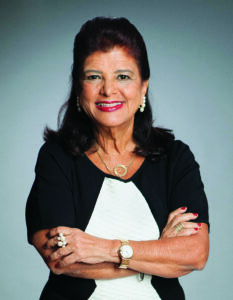
Luiza Helena
Similarly, Liliane Dutra is a seasoned real estate executive in Brazil’s retail property sector. With more than two decades in shopping centre operations and development, she has held senior leadership roles with major retail real estate firms including Multiplan, Brookfield and BRMalls, and until February served as CEO of Carrefour Property Brasil.
From an investor’s perspective, this is increasingly seen as more than a social issue. Large asset owners and limited partners are now folding gender diversity metrics into their manager selection and monitoring processes, particularly for core and value-add real estate funds exposed to retail and mixed-use assets.
For retail-focused REITs and developers, their end customers are often disproportionately female and there is a growing recognition that leadership teams which better reflect those customers may be more attuned to shifts in behaviour.