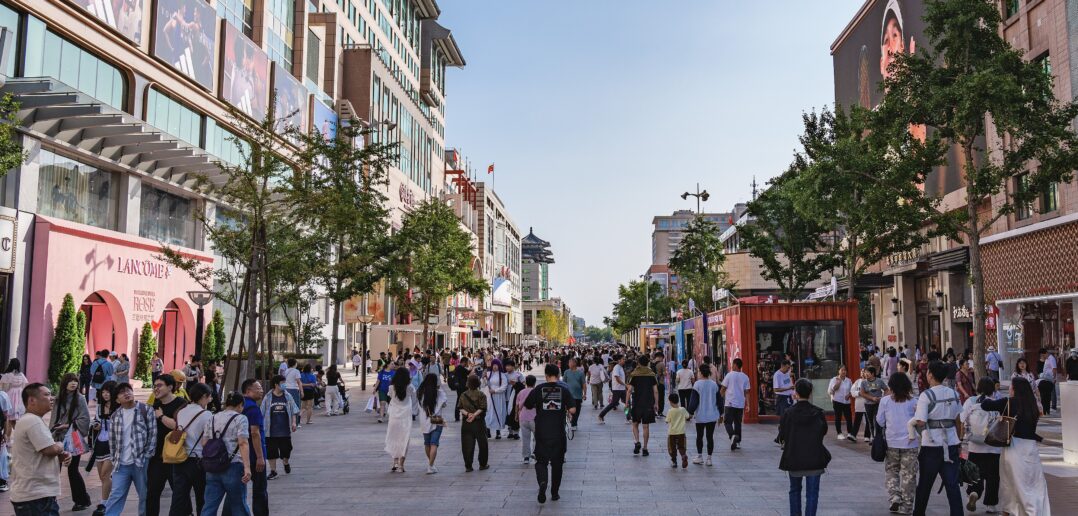
For decades, Wangfujing Pedestrian Street has occupied a unique place in China’s retail hierarchy. Part luxury shopping boulevard, part tourist attraction and part symbol of Beijing’s evolution from imperial capital to global consumer city. Yet in 2026, the famed ‘Golden Street’ is also becoming a test case for how China’s urban retail centres are reinventing themselves amid softer consumer confidence, rising domestic tourism and an increasingly experience-led retail economy.
Stretching through the Dongcheng district of Beijing, Wangfujing has historically been synonymous with flagship department stores, international luxury brands and high tourist footfall. Today, however, its role is shifting again as Beijing attempts to position the district as a centre for what Chinese authorities are calling the ‘debut economy’, a retail strategy focused on first stores, flagship openings, launches and experiential retail concepts.
That strategy has gathered pace over the past year with a reported 45 new first stores and flagship concepts opening during 2025.
Wangfujing’s management has also leaned heavily into festivals, branded cultural events and cross-border collaborations, including a recent sister street partnership with Seoul’s Myeongdong shopping district.
At the same time, the district remains one of Beijing’s most important tourism anchors. During the 2026 Spring Festival holiday, Wangfujing ranked among the city’s most visited destinations as Beijing recorded almost 20 million tourist visits over the holiday period. The blend of shopping, hospitality and cultural tourism has become increasingly important for retail districts across China as domestic tourism spending rebounds faster than discretionary retail purchases.
Yet Wangfujing is also operating in a much more competitive environment than in its heyday. Beijing’s retail landscape has become fragmented, with newer luxury and lifestyle districts such as Sanlitun attracting younger, affluent shoppers and global luxury investment. The reopening and repositioning of Beijing’s Taikoo Li Sanlitun has drawn major flagship openings from brands including Dior, Louis Vuitton and Tiffany, underlining how competition for premium consumers is intensifying across the capital.
But retail conditions remain challenging. Recent analysis from JLL and Caixin highlighted continued pressure on Beijing retail rents during early 2026 as cautious consumer spending weighed on leasing demand. That changing dynamic is visible in Wangfujing itself, with immersive experiences, technology-led concepts and domestic Chinese brands targeting younger consumers. Robotics retailer Unitree Robotics recently expanded into the Wangfujing area, reflecting the growing emphasis on experiential technology retail within Chinese shopping destinations.
The area is also balancing heritage with modernisation. Wangfujing remains closely tied to Beijing’s identity as an international tourism gateway, helped by its proximity to Tiananmen Square, the Forbidden City and many of the capital’s historic landmarks.
But some visitors now see it less as a traditional street market and more as a retail corridor dominated by international brands and large-format shopping centres, with some tourists arguing that the district has lost some of the authenticity that once defined it, with footfall increasingly driven by flagship malls and tourist-oriented retail rather than independent street commerce.
Despite this, Wangfujing remains central to Beijing’s ambitions to build itself into an international consumption hub. China continues to prioritise domestic consumption growth as a core economic driver, and flagship districts such as Wangfujing play an important symbolic and economic role in that strategy.