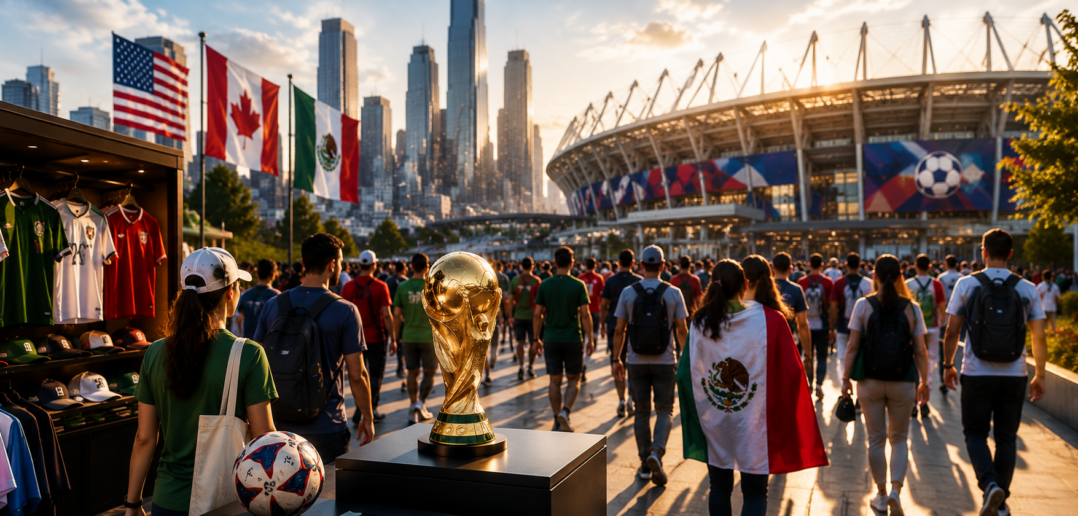
The 2026 FIFA World Cup is shaping up to be the most commercially ambitious sporting event in history, but the question running through retail boardrooms is whether that promise will translate into reality on the ground.

Wikimedia Commons Lula Official
The central tension is the scale of the tournament’s economic projections versus the more uncertain reality facing consumers, retailers and brands. On paper, the numbers are extraordinary. The expanded 48-team World Cup across the United States, Mexico and Canada is expected to generate more than $40 billion in global economic output, attract over six million visitors, and drive billions in sponsorship and marketing spend.
But the assumptions underpinning those forecasts may be increasingly fragile.
At the heart of the opportunity is the sheer commercial reach of the tournament. FIFA has already sold out its global sponsorship tiers, with partners including Adidas, Coca-Cola, Visa and McDonald’s embedded across stadiums, broadcasts and digital platforms. Marketing spend is estimated to exceed $10 billion globally, as brands compete not only for visibility, but for cultural relevance in what is now a fully fragmented media environment.
Brands are no longer simply buying exposure; they are buying access to the fan experience, embedding themselves in how supporters travel, consume and engage with the tournament across multiple screens.
For retailers, the expectation is a surge in demand across hospitality, fashion, travel and experiential spending. Host cities anticipate packed hotels, busy restaurants and strong merchandise sales from official licensing programmes that now stretch well beyond shirts and scarves into toys, collectibles and streetwear collaborations. FIFA’s expanded licensing strategy has turned the World Cup into a year-round retail ecosystem, with brands such as Lego and Panini (for now) extending the tournament’s reach far beyond the stadia.
Yet there is a distinct risk that expectations for international tourism may be overstated. Forecasts of a surge in incremental spending assume smooth travel flows, strong ticket affordability and high discretionary spend at a time when consumers remain cost-sensitive and many have balked at sky high ticket prices plus a perceived lack of welcome from the US hosts.
The competitive landscape for brands adds another layer of complexity. Nike, Adidas and Puma are once again locked in a global battle for visibility, outfitting the majority of national teams and leveraging the tournament as a showcase for both performance innovation and cultural storytelling. Their rivalry is no longer just about shirt sales. It is about long-term brand positioning in an increasingly AI-driven and experience-led retail environment, where engagement matters as much as transaction value.
Meanwhile, retailers and sponsors are also adapting to a shift in how fans consume sport. Digital-first engagement, short-form video, influencer partnerships and real-time content are now central to World Cup marketing strategies.
Even if the upside is uneven, the tournament will still act as a powerful accelerator of brand storytelling, licensing innovation and experiential retail. The key difference this time is that success will depend less on simply being present, and more on whether brands can genuinely integrate into how fans experience the game.
In that sense, the 2026 World Cup is not just a test of retail demand. It is a test of whether global brands still understand how to turn cultural moments into commercial momentum in an era of fragmented attention and cautious consumers.